Drawing the male figure can seem challenging at first, but with the right approach, anyone can learn to create realistic male forms. Whether you’re a beginner just starting out or an experienced artist looking to improve your skills, understanding the basic proportions and structural elements is essential. Learning to draw the male body requires understanding key anatomical differences such as broader shoulders, narrower hips, and more angular features than the female form.
Many artists struggle with male anatomy because they focus too much on details before mastering the underlying structure. By breaking down the male figure into simple shapes, you can build a solid foundation for your drawings. Starting with a stick figure, then adding volume with basic forms like cylinders and blocks helps establish proper proportions before adding muscular details.
Practice is vital to improving your male figure drawings. Try drawing from different angles using tutorials that show multiple perspectives to develop your spatial understanding. Don’t worry about perfection initially – focus on capturing the energy and balance of the pose first, then refine as your skills grow.
How to Draw a Male Figure: Mastering Proportions and Anatomy
Step 1: Understand Basic Male Body Proportions
- The average adult male figure is about 7.5 to 8 heads tall.
- Key proportional landmarks:
- Head: Use the head as a unit of measurement.
- Shoulders: Typically about 2 to 2.5 heads wide.
- Torso: About 3 heads tall from chin to crotch.
- Arms: Reach mid-thigh when relaxed.
- Legs: Make up about half the total height.
- The male figure generally has broader shoulders and a narrower waist compared to the female figure.
Step 2: Sketch the Basic Frame (Gesture and Skeleton)
- Start with a gesture drawing to capture the pose and flow.
- Use simple lines and shapes to outline the spine, rib cage, and pelvis.
- Mark joints with circles: shoulders, elbows, wrists, hips, knees, and ankles.
- Draw a vertical line for balance and posture.
Step 3: Block in Basic Shapes
- Use cylinders for limbs (arms and legs).
- Use an oval or egg shape for the rib cage.
- Use a smaller oval or circle for the pelvis.
- Connect shapes with smooth lines to form the body’s structure.
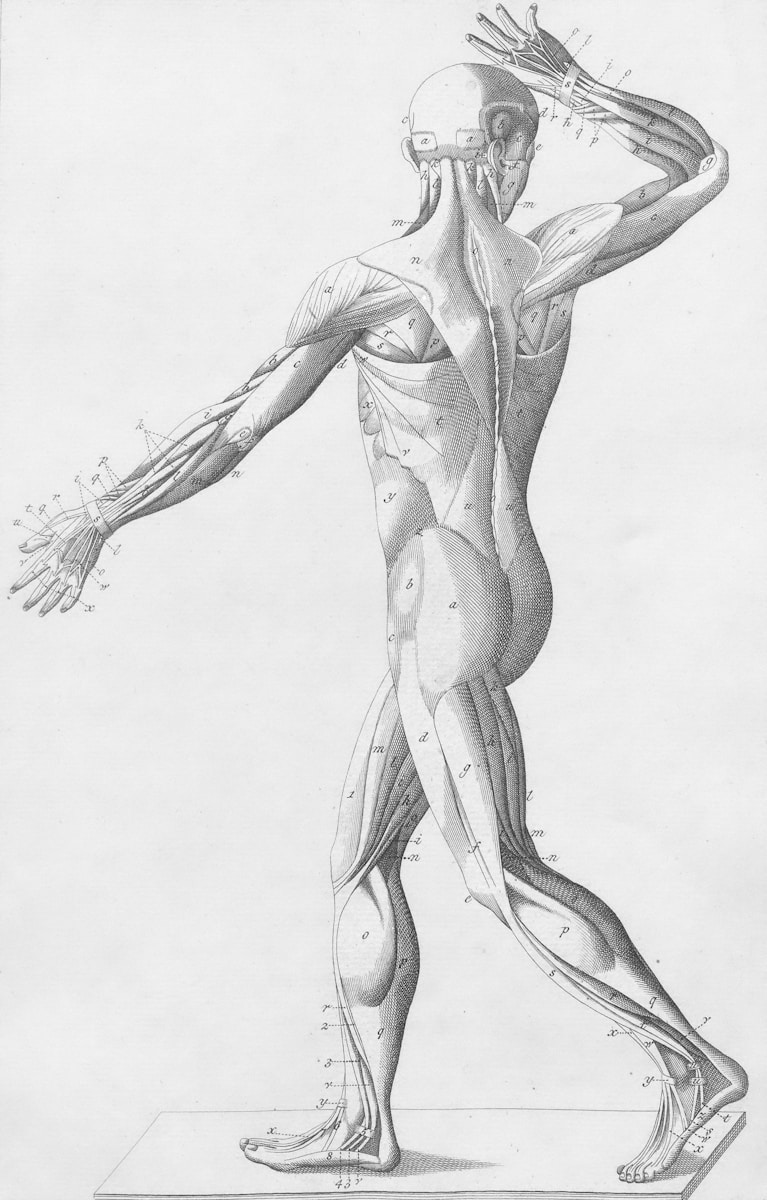
Step 4: Add Muscle Structure
- Study major muscle groups:
- Chest (Pectorals): Broad and defined.
- Shoulders (Deltoids): Rounded and prominent.
- Arms: Biceps and triceps on the upper arm; forearms taper down.
- Abdominals: Typically a six-pack or defined core.
- Back muscles: Trapezius and latissimus dorsi create width.
- Legs: Quadriceps, hamstrings, and calves give volume.
- Use reference images or anatomy charts to understand muscle placement.
Step 5: Refine the Outline and Add Details
- Smooth out the shapes into a more natural human form.
- Add hands and feet with attention to proportion.
- Define facial features, hair, and neck muscles.
- Keep proportions consistent as you refine.
Step 6: Shading and Texturing (Optional)
- Use shading to emphasize muscle definition and volume.
- Light source direction helps create realistic shadows.
- Add skin texture or clothing folds if desired.
Tips for Mastery
- Practice drawing from life models, photos, or anatomy references.
- Use the head measurement method consistently.
- Study male anatomy books or tutorials for deeper understanding.
- Experiment with different poses and perspectives.
- Keep sketches loose at first, then gradually add detail.
Useful Resources
- Mastering the Male Figure: A Step-by-Step Drawing Tutorial
- How to Draw a Man – Mastering the Basic Proportions
- How To Draw Basic Human Body Proportions (With Template!)
Key Takeaways
- Start with basic shapes and proportions before adding muscular details for more accurate male figure drawings.
- Male bodies typically feature broader shoulders, narrower hips, and more angular facial features than female forms.
- Regular practice with different angles and poses builds muscle memory and improves your ability to capture realistic male figures.
Fundamentals of Figure Drawing
Drawing the male figure requires understanding key principles that will strengthen your artistic foundation. These principles focus on proportions, shapes, and specific characteristics that define the male form.
Understanding Proportions
The male figure is typically measured in “heads” as a unit of measurement. A standard male figure stands about 7.5 to 8 heads tall. This means the entire height of the figure is equal to 7.5-8 times the height of the head.
The torso usually spans about 3 heads in length. Your measurements should place the halfway point of the body near the pubic bone, not at the waist as many beginners assume.
Arms typically reach mid-thigh when hanging naturally, with the wrist aligning with the crotch. The hands, when fully extended, should reach about mid-thigh.
Remember these key proportional relationships:
- Shoulder width: approximately 2.5-3 head widths
- Distance from nipple to nipple: about 1 head width
- Waist: approximately 1.5-2 head widths
Starting with Basic Shapes
Begin your figure drawing with simple geometric forms. This approach helps establish a solid foundation before adding details.
The male torso can be visualized as a modified box or cylinder. The chest resembles a rectangle that tapers toward the waist, while the pelvis forms a smaller box below.
Draw the head as an oval or egg shape. The neck is a simple cylinder, while the limbs can be blocked in as cylinders of varying widths.
Try this basic shape breakdown:
- Head: Oval
- Chest: Rectangular prism
- Pelvis: Smaller rectangular prism
- Arms and legs: Cylinders
- Hands and feet: Wedge shapes
Using these basic shapes creates a scaffold that helps you visualize the three-dimensional form before adding anatomical details.
Defining the Male Figure
The male figure has distinct characteristics that differentiate it from the female form. Males typically have broader shoulders, narrower hips, and more defined musculature.
The male torso features a more prominent rib cage and rectangular shape. Pay special attention to the male torso as it defines much of the masculine appearance through its angular qualities.
When drawing the male figure, emphasize these key features:
- More angular jawline and facial features
- Broader shoulders compared to hips (creating a V-shape)
- More visible muscle definition, especially in the abdomen, chest, and arms
- Less body fat, resulting in more visible bone landmarks
The male pelvis sits more vertically than the female pelvis. This affects the entire stance of your figure and creates the characteristic straight lines of the male form.
The Structural Elements
Understanding the main structural elements of the male figure is essential for creating drawings with anatomical accuracy. These foundational parts determine the overall pose, proportions, and energy of your figure.
Drawing the Torso
The male torso tends to have a more rectangular or trapezoid shape compared to the female form. Begin with a simple box shape, slightly narrower at the bottom than at the top. This basic structure will help you visualize the three-dimensional form.
The male chest is typically defined by pectoral muscles that form rectangular shapes on either side of the sternum. When drawing the male body at different angles, remember that these muscles connect from the sternum to the upper arm.
The abdominal area can be divided into segments:
- Upper abs (2 sections)
- Middle abs (2-4 sections)
- Lower abs (often hidden by the navel)
Pay attention to the rib cage placement. It extends from the sternum and tapers toward the waist, creating the classic V-shape of the male torso. Many beginners make the mistake of drawing the torso too long, so use the head as a measuring unit—the torso is typically 3 to 3.5 heads tall.
Constructing the Pelvis
The pelvis serves as the foundation for the lower body and connects to the torso at the waist. For males, start by drawing a simplified version that resembles a bowl or bucket shape. Make it narrower and more angular than a female pelvis.
Key landmarks to include:
- Iliac crests – the top edges of the pelvis that create the “handles” on either side
- ASIS points – anterior superior iliac spine, the front points that are often visible
- Pubic symphysis – the central connecting point at the front bottom
When constructing the body, position the pelvis slightly below the end of the rib cage, with about one-half to one head unit of space between them. This gap creates the waist region.
The pelvis tilts slightly in different poses. In a standard standing pose, the front is slightly higher than the back. This tilt changes dramatically when the figure is in motion.
Shoulders and Shoulder Blades
The shoulders form the widest part of the male figure and consist of the deltoid muscles and clavicles. The male shoulder width typically spans about 2-2.5 head widths, significantly wider than the pelvis.
The clavicles (collarbones) extend from the sternum outward and slightly upward before connecting to the acromion process of the shoulder. Draw them as slightly curved lines that create the top boundary of the chest.
The shoulder blades (scapulae) sit on the back of the ribcage and move substantially with arm positions. When the arms are relaxed, the shoulder blades lie flat. When arms raise, the blades rotate and may become more visible.
To draw realistic movement, remember that the shoulder blades move with the arms, creating different surface forms depending on the position. This relationship is crucial for drawing believable back muscles and arm connections.
Use the “ball and socket” concept when connecting arms to shoulders. The shoulder joint allows for extensive movement, which you should indicate by drawing the deltoid wrapping around a spherical form.
Dynamics of the Male Figure
The male figure comes alive through movement and weight distribution. Understanding how the body naturally shifts creates drawings with energy and realism.
Capturing the Tilt of the Pelvis
The pelvis serves as the foundation for dynamic poses. When drawing a male figure, notice how the pelvis tilts in response to shifting weight. This tilt creates a natural curve in the spine and affects the entire posture.
In relaxed standing poses, the pelvis typically tilts slightly toward the supporting leg. This creates what artists call the line of action that flows through the figure.
Try these simple steps:
- Draw the pelvis as a simplified box
- Indicate which leg bears weight
- Tilt the pelvis down toward the supporting leg
- Note how this tilt affects the position of the legs and torso
When the weight shifts, the hip on the supporting leg side rises while the opposite hip dips lower.
Understanding the Motion of the Shoulders
The shoulders counter-balance the pelvis in dynamic poses. When the pelvis tilts one way, the shoulders typically tilt in the opposite direction to maintain balance.
This counter-rotation creates dynamic tension throughout the torso. Male shoulders are generally broader and more angular than female shoulders, making this counter-movement even more pronounced.
Key points to remember:
- Shoulder girdle (clavicles and scapulae) moves as a unit
- When one shoulder drops, the other rises
- Shoulders rotate opposite to the pelvis
- The ribcage connects these two opposing movements
Pay attention to how arm positions affect shoulder placement. Raised arms pull shoulders upward, while weight-bearing arms compress the shoulder downward.
Incorporating Contrapposto
Contrapposto—the asymmetrical stance where weight rests primarily on one leg—is fundamental for creating natural, dynamic male figures. This stance creates a subtle S-curve through the body that feels alive rather than rigid.
In contrapposto, the male mannequin shows these characteristics:
- Weight-bearing leg straightens
- Non-weight-bearing leg relaxes and bends
- Pelvis tilts down toward the straight leg
- Shoulders tilt opposite to the pelvis
- Navel twists slightly toward the relaxed leg
Renaissance artists used contrapposto extensively to bring vitality to their sculptures and paintings. When drawing from reference, look for these weight shifts even in subtle poses.
Practice by drawing simple stick figures in contrapposto first. Once you grasp the basic weight distribution, you can add anatomical details to flesh out your figure.
Creating Realism
Adding realism to your male figure drawings requires careful attention to proportions, texture, and lighting. These elements work together to transform a basic sketch into a lifelike representation.
Refining Body Proportions
The male body typically follows specific proportional rules that help create realistic figures. A standard male figure is about 7-8 head lengths tall. The shoulders should be approximately 2-3 head widths across, creating that characteristic inverted triangle shape.
When drawing a seated figure, remember that the body compresses. Pay attention to how the spine curves and how weight distributes across the sitting surface. You can study proportional methods specifically for seated poses to improve accuracy.
The neck should position the head properly—not too low or forward. Common mistakes include making the head too large or the limbs too short. Use reference photos or anatomy books to check your proportions as you work.
Capturing Skin Tone and Texture
Skin isn’t one flat color—it has depth and variation. Begin with a mid-tone base and gradually build layers to create dimension. For male figures, emphasize slightly rougher skin texture, especially in areas like hands, elbows, and knees.
Toned paper works excellently for realistic skin rendering. It provides a neutral middle value that lets you add both highlights and shadows effectively.
Consider factors that affect skin appearance: age, sun exposure, and muscle definition. Younger male skin appears smoother, while mature skin shows more texture and lines. Areas with thin skin (like around eyes) will show underlying structures more clearly.
Add subtle color variations—slightly redder tones around joints, bluish tints where veins are visible, and yellower tones in fatty areas.
Rendering Light and Shadow
Lighting creates the illusion of three-dimensionality in your male figure drawings. Start by deciding on a single light source and consistently apply shadows based on its direction.
The male form has prominent muscle groups that cast characteristic shadows. Pay special attention to the planes of the chest, the shadow under the pectoral muscles, and how light wraps around biceps and forearms.
Use at least three values in your shading: highlights, mid-tones, and shadows. For greater realism, add a fourth value—the darkest shadows in areas like under the chin or between fingers.
Work with various pencil techniques to create different textures. Hatching works well for creating smooth gradients on skin, while stippling can suggest pores or subtle texture. When drawing male faces, use firmer pressure for typically stronger features like brow ridges and jawlines.
Facial Features and Details
The face is the most expressive part of the male figure and requires special attention to detail. Getting the proportions right and understanding how to add realistic features will make your drawings more lifelike and memorable.
Drawing the Head and Face
Start with basic proportions for a male face. The face can be divided into three equal sections: hairline to eyebrows, eyebrows to bottom of nose, and nose to chin. Draw a circle for the cranium, then add the jaw beneath it.
Male faces typically have stronger jawlines and more angular features than female faces. The jaw should be more square with defined edges. The cheekbones are often more prominent as well.
When drawing the face from different angles, remember that facial features follow the planes of the face. Study facial structure and planes to understand how features wrap around the skull.
Use these guidelines for male face proportions:
- Eyes placed halfway down the head
- Eyes spaced one eye-width apart
- Ears aligned between eyebrows and nose bottom
- Mouth positioned about one-third between nose and chin
Adding Realistic Features
Eyes in male figures often appear smaller and deeper set with more pronounced brow ridges. Draw eyebrows slightly thicker and less arched for a masculine look.
The nose can be more prominent with a broader bridge and nostrils. When drawing male facial features, pay attention to the nose bridge width and nostril flare.
For lips, make them thinner than female lips, especially the upper lip. Male lips typically have less defined borders and more subtle coloring. Avoid drawing large pouty lips as they can feminize your male figure.
Creating realistic hair requires careful observation. Male hairstyles vary widely, but focus on the hairline shape, which often forms an “M” shape as it recedes at the temples. Draw hair in masses rather than individual strands.
Detailing the Facial Expressions
Male facial expressions need to work with the underlying musculature. The temporalis, masseter, and buccinator muscles influence how expressions form on the face.
To draw convincing expressions, study how these key elements change:
- Eye shape: How the eyelids tighten or relax
- Eyebrow position: Raised, furrowed, or neutral
- Mouth corners: Up for happiness, down for sadness
- Forehead wrinkles: Horizontal for surprise, vertical for anger
A helpful technique is to practice drawing basic expressions like joy, anger, sadness, and surprise. Observe yourself in a mirror making these expressions to see how your own face changes.
Remember that subtle expressions often look more natural than exaggerated ones. Small adjustments to the eyes and mouth can dramatically change the emotion conveyed in your drawing.
Educational Resources
Learning to draw the male figure becomes easier with the right educational materials. These resources range from traditional books to modern online platforms and personalized instruction.
Books and Online Courses
Several excellent books can help you master male figure drawing. Joseph Sheppard’s “Drawing the Male Figure” is a comprehensive guide with 250 illustrations showing various positions and perspectives. It breaks down complex anatomy into manageable lessons.
For digital learners, video tutorials offer step-by-step guidance. Channels like Draw With Waffles provide male figure studies with helpful reference collections. These videos walk you through the process while explaining key anatomical concepts.
Online courses often include:
- Downloadable reference sheets
- Community feedback
- Progressive lessons from basic to advanced
- Lifetime access to materials
Many platforms offer specialized courses focusing on male proportions, which differ significantly from female figures.
Life Drawing Academy Offerings
Life Drawing Academy provides structured programs specifically for figure drawing skills. Their male figure courses typically focus on accurate proportions and anatomical landmarks.
The academy offers both live and recorded sessions where you can watch professional artists demonstrate techniques for capturing the male form. Their step-by-step approach helps you understand proportions correctly.
Key offerings include:
- Figure drawing fundamentals
- Anatomy workshops
- Pose libraries with male models
- Critique sessions with instructors
Their curriculum often covers the proportions, mnemonics, and landmarks needed to draw male figures convincingly. You’ll learn important concepts about body divisions and how to avoid common mistakes with head proportions.
Personal Tutoring for Artists
One-on-one instruction provides tailored feedback that group classes can’t match. Personal tutors can identify your specific weaknesses and create customized exercises to address them.
When selecting a tutor for male figure drawing, look for someone with:
- Demonstrable skill in anatomical drawing
- Teaching experience
- Specialization in figure work
- Clear communication style
Many tutors offer online sessions where they can critique your work through screen sharing. This allows you to receive guidance regardless of your location.
Some tutors provide homework assignments between sessions to reinforce concepts. This practice-oriented approach helps you internalize male figure proportions and anatomical knowledge more effectively than passive learning alone.
From Foundation to Advanced Techniques
Creating realistic male figures requires building skills progressively from basic foundations to more complex techniques. These methods help you develop accuracy and confidence in your figure drawings.
Measuring Proportions Accurately
The male figure typically follows specific proportions that you can use as guidelines. The average male body is about 7-8 heads tall, with the midpoint of the body landing at the pubic bone.
When measuring proportions, use your pencil as a measuring tool by extending your arm fully and closing one eye. This helps you compare different body parts accurately.
The shoulders on male figures are generally about 2-3 head widths wide, while the waist is narrower at approximately 1-1.5 head widths. The distance from the shoulder to the elbow roughly equals the distance from the elbow to the wrist.
Try dividing your page into eight equal sections when beginning, creating a measurement grid that helps maintain proper body proportions.
Advanced Stick Figure Framework
Start with a simple stick figure that captures the pose’s energy and structure. This framework serves as your roadmap for the entire drawing process.
For male figures specifically:
- Draw an oval for the ribcage
- Add a smaller oval or circle for the pelvis
- Connect them with a curved line for the spine
- Add straight lines for limbs, noting joint positions
The male torso typically forms an inverted triangle shape, with broader shoulders and narrower hips. Mark the key joints – shoulders, elbows, wrists, hips, knees, and ankles – with small circles.
This advanced stick figure should indicate weight distribution and the body’s center of gravity. The line of action, a curved line running through the figure, helps convey movement and energy.
Developing a Refined Drawing Process
Building on your framework, develop a methodical drawing process that moves from general to specific details. Start by refining the major masses of the body using simple geometric shapes.
For the male figure:
- Expand stick figure into 3D forms (cylinders for limbs, box for torso)
- Add volume to the chest and shoulders
- Define the major muscle groups
- Refine contours and add anatomical details
Pay attention to the distinct male anatomy features like broader shoulders, more defined muscle groups, and angular facial structure. The male figure typically has less body fat, making muscle definition more visible.
When adding detail, focus on anatomical accuracy in areas like the chest, shoulders, and arms. Use shading to emphasize muscle definition and create a sense of volume.
Remember that regular practice with reference images or life models will significantly improve your ability to draw convincing male figures.
Diverse Body Types
Male bodies come in many shapes and sizes. Learning to draw this variety will make your art more realistic and inclusive.
Identifying Different Male Body Types
Men’s bodies typically fall into a few general categories. The ectomorph body type is thin with narrow shoulders and hips. Mesomorphs have athletic builds with broad shoulders and a V-shaped torso. Endomorphs have rounder shapes with more body fat distribution.
When drawing different types, pay attention to:
- Shoulder width relative to hips
- Muscle definition (prominent or subtle)
- Fat distribution patterns
- Overall proportions and silhouette
You can study resources for diverse body types to improve your skills. Books like “Morpho: Fat and Skin Folds” are excellent for understanding plus-sized and older bodies.
Remember that most men won’t fit perfectly into one category. Many have combination features that make them unique.
Adapting Proportions for Variance
When drawing different male body types, you need to adjust standard proportions. For muscular builds, shoulders might be 1.5-2 times wider than the hips. For larger bodies, the torso may appear shorter relative to the legs.
Try using simple shapes to build different body structures:
- Use larger circles for endomorphs
- Use trapezoid shapes for mesomorph torsos
- Use narrower shapes for ectomorphs
Height proportions can vary too. The average male figure is about 7-8 heads tall, but this can change based on body type. Taller, slimmer figures might be 8-8.5 heads tall, while shorter, stockier builds might be closer to 6-7 heads.
Practice drawing the same pose with different body types to understand how weight and muscle affect form.
Aligning with Realistic Anatomy
Even when drawing stylized figures, understanding realistic anatomy helps create believable diverse bodies. Muscle and fat behave differently across body types.
Key anatomical considerations:
- Fat distribution – Men typically store fat first in the abdomen
- Muscle visibility – Varies greatly between body types
- Skin folds – Appear differently based on weight and age
For athletic builds, emphasize the trapezius, deltoids, and pectorals as these create the V-shaped upper body. For larger builds, remember that muscles still exist beneath fat layers.
When drawing older male figures, include age indicators like looser skin along the jawline or more pronounced joints. This creates more authentic and diverse representations in your artwork.
Frequently Asked Questions
Drawing the male figure requires understanding key anatomy, proportions, and techniques. The following questions address common challenges artists face when sketching men.
What are the basic steps to sketch a male body?
Start by drawing a simple stick figure to establish pose and proportions. The average male figure is about 7.5 to 8 heads tall in height.
Next, add basic shapes to outline the torso, limbs, and head. The male torso typically has broader shoulders and a narrower waist compared to females.
Finally, refine your sketch by adding muscles, facial features, and details. Remember to keep your lines light at first so you can easily erase and adjust as needed.
What techniques are recommended for easily drawing male figures?
The block method is highly effective, where you break down the body into simple geometric shapes before adding details. This helps maintain proper proportions throughout your drawing.
Regular practice with torso studies enhances the expressiveness of your figures. Focus on understanding how muscles connect and interact.
Using reference photos or life drawing sessions will significantly improve your ability to capture realistic male anatomy and poses.
Which pencil shading techniques should be used for rendering a male figure?
Cross-hatching works well for defining muscle groups and creating dimension. Apply this technique with varying pressure to show depth in areas like the chest and abdomen.
For smooth skin transitions, use blending stumps or tortillons to soften harsh lines. This creates more realistic skin textures across the body.
Highlight areas that catch light, like shoulders, chest, and forehead, by leaving them lighter or using an eraser to remove graphite selectively.
How can I draw male clothing on a figure realistically?
Always sketch the figure underneath first, even lightly, to understand how clothing drapes over the body. This ensures natural-looking folds and proportions.
Pay attention to how fabric stretches across broader areas like shoulders and chest while creating folds in areas of movement or compression.
Consider the weight of different fabrics – t-shirts cling closer to the body while heavier materials like denim or wool create more structured shapes with fewer small folds.
What are the proportions to consider when drawing a male face?
The male face typically has a more angular jawline and pronounced brow ridge. Place eyes approximately halfway down the head.
The width of the face is usually about five eye-widths across. The bottom of the nose falls roughly halfway between the eyes and chin.
Male lips are generally thinner and less defined than female lips, with a more prominent philtrum (the groove between nose and upper lip).
What is the best way to achieve realism when sketching the male form?
Study anatomy books to understand muscle structures beneath the skin. Knowing what lies beneath helps create believable surface forms.
Observe how light interacts with different body parts. The expressiveness of your figures depends greatly on accurate lighting.
Practice drawing specific body parts repeatedly until you master them. Hands, feet, and faces require extra attention due to their complexity.